Tetras

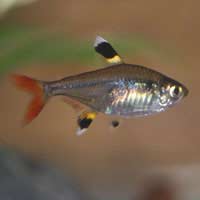
Brightly coloured highly active and extremely friendly, tetras are among the most popular of all aquarium fish. They fit in well in community tanks and always provide lots of action. They are also relatively hardy and easy to keep, provided there are no other fish in your aquarium big enough to eat them.
Tetras will accept a wide range of foods and are generally happy on a flake diet, but for best results they should be given live food every couple of weeks. They are fairly adaptable as regards water conditions, but are sensitive to sudden changes, so you should be extra careful when moving them, giving them plenty of time to adjust. In poor water conditions they will sometimes develop a muscle wasting disease which cannot be cured. If this happens (the first sign usually being a limp tail), check your water parameters and do what you can to decrease pollution before more of your fish are affected.
Tetras are highly sociable and should be kept in groups of six or more of the same species. They get on well with all other naturally peaceful species of around the same size, though they may be bullied by fish like danios and gouramis and bullying can lead to illness. Larger tetra shoals help to reduce bullying by other species. It's also useful to provide hiding places, especially among plants.
Types of Tetras
There are over one and a half thousand species of tetra in the wild, and several dozen types are available within the aquarium trade. Listed below are some of the most popular:- Neon Tetras -Among the most popular of all aquarium fish, these delightful little creatures are very friendly and always busy. They are known for their distinctive bright red and blue colouring, but a black variety is also available. They can be fragile at first, but do well once they have adapted to an established environment.
- Glowlight Tetras -With their distinctive golden stripes, these are charming little fish, but they are comparatively solitary and can be shy. They are adaptable and fairly easy to keep.
- Lemon Tetras -The beautiful yellow colour of these fish is brightest when they are happy in a heavily planted aquarium. They benefit from slightly acidic water and tolerate a good range of temperatures.
- Buenos Aires Tetras -Growing to three or more inches in length, these fish are easier to keep with larger species in a community tank. They are fairly hardy. They can occasionally be aggressive, and are savage in their treatment of plants.
- Butterfly Tetras -Also known as blackamoors, these handsome black and silver fish are friendly towards other species but can be aggressive towards their own kind. They need slightly acidic water and will only accept food in appropriately small pieces.
- Rummy Nose Tetras -With red noses and striking black and white stripy tails, these fish will fade in poor water conditions. They are happiest in large shoals.
Breeding Tetras
Tetras are comparatively easy to breed. Males are usually more vividly coloured than females and are a slimmer, more angular shape, the difference being especially notable when the females are gravid with eggs. Eggs are laid in large clusters roughly once every two weeks, but the parents (and other fish) will eagerly eat them, so if you want any young to survive you will have to use a separate spawning tank. This should contain plenty of vegetation and a coarse gravel substrate in which eggs can go unnoticed, or you can use a spawning net which the eggs will fall through, out of reach of the parents. Tetras breed most eagerly in slightly acidic water. Because the males can be aggressive when trying to fertilise the eggs, you should consider breeding with more than one female to each male, to divide his attentions, and you should be ready to remove the male from the spawning tank if he gets too rough.Tetras are personable, lively fish which can be lots of fun to watch, and they make a great addition to any community of suitably sized fish. Suitable for all levels of aquarium experience, they have lots to offer in return for your care, and they're well worth getting to know.

Re: Providing Toys for Your Fish
Toys for my baby Flowerhorn fish??? And where to buy them ?
Re: Snail Infestations in Your Fish Tank
My coy fish just started darting and running into the glass. I've checked them over and see nothing on the outside of…
Re: My Pet Fish is 20 Years Old is this a Record?
I purchased a gold fish on April 1997 for my daughters and the same fish is alive and well. The reason I'm…
Re: Dealing with Bullying Between Fish
I have 3 Bolivian butterfly rams not sure the genders,but at the start all 3 were fine but just recently we’ve notice 2…
Re: Using Electrical Devices Safely In Your Aquarium
Monthly water changes isn’t enough I would be changing at least a 1/3 weekly. I do it more often than…
Re: Dealing with Bullying Between Fish
I have a blue gourami that has been living with 4 platty’s and a yoyo loach. I noticed a couple of my fish missing. I…
Re: Lighting for Aquatic Animals
Will a UV submersible light harm my tropical tank and fish. Thanks for any help
Re: Dealing with Bullying Between Fish
Recently put 12 new Africans in my 55 gallon tank. Many rocks and hiding places. After 2,3 days one of them, obliquidens,…
Re: Food Quantities
Just noticed smallest neon tetra tail is missing and white on the edges. Another also has half of tail missing. They was OK a few days ago. I only…
Re: Providing Toys for Your Fish
I have guppies and I think the ideas for toys might be too big, I have tried training them but they aren't responding.